

How to Keep Squirrels Off Your Bird Feeder Pole
You refill the bird feeder, then find a squirrel helping itself while seed spills onto the ground. You may not mind squirrels in the yard, but constantly replacing food meant for the birds gets frustrating.
And if you’ve already added a baffle, seeing a squirrel back on the feeder can leave you wondering what went wrong.
Start by watching how it reaches the food. A pole-mounted baffle helps block the climb, but it won’t stop a squirrel from jumping onto the feeder from a nearby fence or branch. The route tells you what to change first.
1. Find Out How the Squirrel Gets There
Before moving the station or buying another accessory, watch one visit from start to finish. If you keep missing the approach, a short recording may help.
Look for three possible routes:
- Climbing the pole: The squirrel works its way up from the ground.
- Jumping from nearby: It launches from a branch, fence, railing, or roof.
- Reaching a low accessory: It gets onto a feeder or tray without passing the baffle.
Seeing a squirrel eating doesn’t tell you how it arrived. Follow its approach so you can address the actual problem.
2. Leave Space Around the Feeding Station
If the squirrel jumps onto the station from elsewhere, start with placement.
Aim for at least 10 feet of clearance from potential jumping points, including trees, fences, and buildings. Check the distance to the hanging feeders, not just the center pole, and look above the station for overhanging branches.
A spot beside the deck may make refilling convenient, but the railing can also provide an easy route to the food.
If your yard doesn’t have enough open space, a squirrel baffle alone may not solve the problem. A weight-activated feeder is another option. Its placement still matters: a squirrel should not be able to reach the food while keeping its weight on a nearby surface.
3. Check the Baffle Height and Feeder Positions
A baffle interrupts the route up the pole. Its installation matters, but so does the position of everything around it.
Position the Baffle Top About 47 Inches Above Ground
For Joywink stations, we recommend positioning the top of the baffle approximately 47 inches (1.2 m) above ground level.
Measure from the ground to the top of the baffle—not its lower edge or mounting point. This is our recommended installation height, not a guarantee that squirrels cannot get past it. For other baffle designs, follow the manufacturer’s instructions.
Once installed, check that the baffle and its support are assembled as directed.
Leave Clearance Below Hanging Feeders
Keep both adjustable lower hooks above the baffle.
For Joywink stations, we recommend leaving at least about 8–12 inches (20–30 cm) between the baffle’s top and the lowest part of a hanging feeder.
Check the gap with the feeder in place. A long tube feeder can hang much closer to the baffle than the hook position suggests.
Include the Tray and Bird Bath in Your Check
The mesh feeding tray and bird bath on both Joywink sizes have height-adjustable support rings.
Watch whether a squirrel uses either accessory—or its support—as a foothold. If it does, adjust that position and observe again. Protecting the hanging feeders won’t help if another part of the station provides a way around the baffle.
4. Make One Change, Then Watch Again
You don’t need to rebuild the entire setup at once. Make a change based on the route you observed, then watch the next visit.
| What you see | What to check first |
|---|---|
| A squirrel jumps from a fence or branch | Move the station farther from that jumping point. |
| It climbs past the baffle | Check the installation height, assembly, and nearby footholds. |
| It reaches food from near the baffle | Check the clearance below the hanging feeder. |
| It jumps directly onto a low tray or feeder | Reposition that accessory so it doesn’t bypass the baffle. |
| It’s already eating when you notice it | Watch or record its approach before changing anything else. |
Keep everyday maintenance in mind. Raising every feeder out of reach may make refilling harder without fixing the squirrel’s route.
Avoid Greasing the Pole
Grease, oil, or petroleum jelly may seem like an easy way to make a pole harder to climb. Avoid them: they can get onto squirrels’ fur and interfere with its insulating properties.
Focus on placement and physical barriers instead. The goal is to keep squirrels out of the bird food, not remove them from your yard.
Choosing a Bird Feeding Station With a Baffle
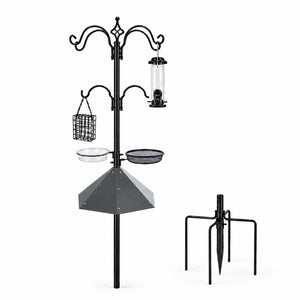
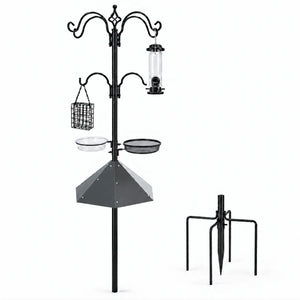
If squirrels are climbing a bare pole, a station with a squirrel baffle provides a barrier designed for that route. It still needs an appropriate location and carefully positioned accessories.
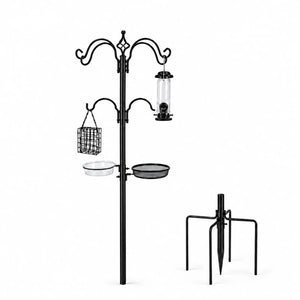
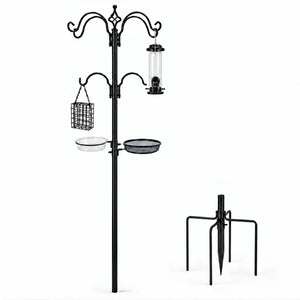
Joywink’s 83″ and 97″ stations are both available with a baffle, adjustable lower hooks, and adjustable supports for the bird bath and mesh feeding tray.

83″ Bird Feeding Station With Squirrel Baffle
Lower top hooks make this the starting point if easier access is your priority. Check your comfortable reach before choosing where to hang each feeder.
Explore the 83″ Station →
97″ Bird Feeding Station With Squirrel Baffle
Choose a taller arrangement while using the adjustable lower hooks and support rings to keep frequently used accessories accessible.
Explore the 97″ Station →Choose the height that suits your feeding routine. A taller pole alone does not prevent squirrels from jumping across from nearby structures.
Before adding another fix, watch how the squirrel reaches the food. That observation will help you decide whether to move the station, adjust an accessory, or revisit the baffle installation.